Broadcom’s AI Financing Deal Adds Risk to an Already Expensive Business
Broadcom’s chip sales and cash flow are surging, while a $63 billion equipment financing deal could leave it covering losses of up to $43 billion.
Broadcom’s AI business is producing substantial sales and cash, but a new equipment financing arrangement ties some of its future results to whether a major customer keeps paying its bills. The deal could support further chip sales. It also leaves Broadcom exposed to losses if the equipment cannot cover the debt after a missed lease payment.
Four major financial firms announced a joint $63 billion financing deal last month. The money is intended for AI equipment built with Broadcom chips, which will be leased to Anthropic, the company behind the Claude chatbot. Broadcom has agreed to help cover losses if Anthropic fails to make lease payments and the equipment cannot be sold for enough to repay the debt.
The maximum exposure described in the source is as much as $43 billion. Broadcom says a payout of that size is unlikely and that the amount at risk will decline as Anthropic makes lease payments. Those points matter: the full figure is a potential obligation, not a stated expected loss. Still, the arrangement gives Broadcom a financial stake in the customer’s ability to meet its commitments over time.
Why Broadcom is taking on the exposure
The company’s recent results help explain the decision. In the third quarter, Broadcom’s revenue rose 86% to $29.6 billion. AI chip sales increased 221% to $16.7 billion. Broadcom also generated $13.7 billion in free cash flow during the quarter, nearly double its amount from a year earlier.
Those figures point to a business already earning significant revenue from AI, rather than one relying only on the possibility of future demand. Broadcom also has an infrastructure software business that helps large companies run and manage technology systems. That segment gives the company another source of revenue alongside its chips.
The scale of the results is striking for a company the source describes as having a market value of around $1.4 trillion and ranking eighth among S&P 500 companies. Rapid sales growth and strong cash generation can give a business more room to support customer financing. But neither guarantees that demand will continue at the same pace or that a customer will meet obligations years into a lease.
Here’s the trade-off: financing equipment may help customers acquire systems built with Broadcom chips, which could support sales. In exchange, Broadcom accepts some downside if lease payments stop and the equipment’s resale value falls short of the debt. If demand for AI equipment weakens, a customer could face more difficulty meeting payments, while the equipment may not recover enough value to close the gap.
What the valuation measures say
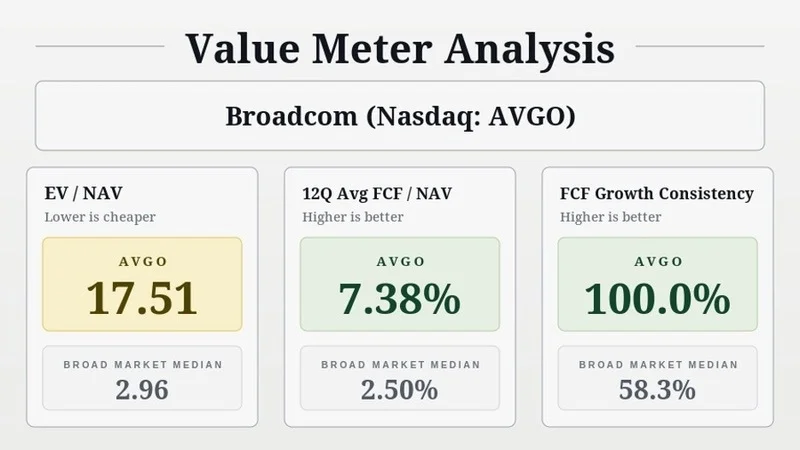
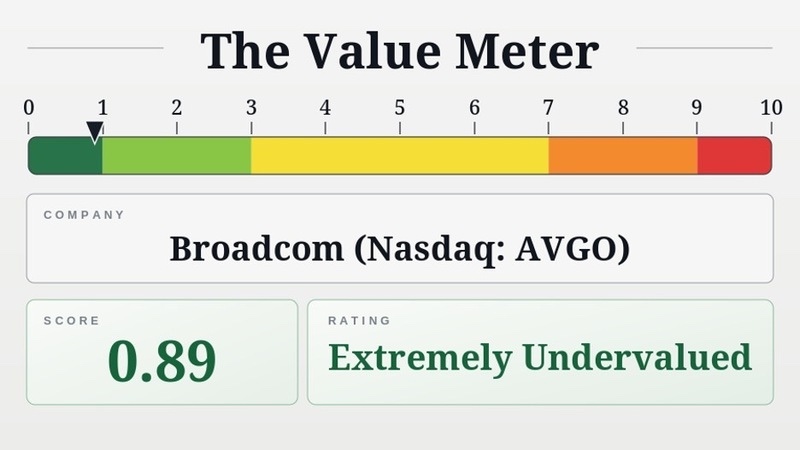
The source’s Value Meter compares a company’s price with its assets, the cash those assets generate, and how consistently that cash flow improves. By the price measure alone, Broadcom stands well above the typical company in the comparison: its enterprise value is 17.51 times its net asset value, compared with 2.96 for the typical stock.
Net asset value, or NAV, is what a company owns minus what it owes. The cash flow figures offer a different view of the price. Over the past 12 quarters, Broadcom’s average quarterly free cash flow equaled 7.38% of NAV. The average stock in the source’s comparison produced 2.50%.
Broadcom also increased free cash flow from a year earlier in each of those 12 quarters. That consistent record helps explain how the Value Meter reaches a favorable rating despite the high price multiple: the company has repeatedly converted its assets into cash at a rate well above the comparison average.
The source labels Broadcom “Extremely Undervalued.” That is the Value Meter’s assessment, based on its chosen measures; it doesn’t remove the financing risk or settle whether the shares suit a particular household’s goals, finances, or comfort with price swings. The financing arrangement introduces another factor to consider alongside the company’s cash generation and valuation.
The two sides of the story should stay in view at the same time. Broadcom’s recent results show powerful growth and cash production, while the lease arrangement creates exposure to future payments and the value of specialized equipment. The maximum stated risk is large, even though Broadcom says that a loss of that scale is unlikely and that its exposure should decline as payments arrive.
For readers assessing the company’s financial profile, the practical takeaway is to weigh its demonstrated cash flow against the duration and size of its financing commitments. Sales growth describes what Broadcom is earning now; the lease exposure depends partly on how reliably a customer pays and what the equipment can recover if those payments stop.
The original post appeared on Wealthy Retirement, which publishes the Value Meter analysis. Its publisher is Wealthy Retirement.