Micron’s AI Boom Brings Record Results and a Familiar Memory Chip Risk
AI demand has lifted Micron’s revenue and margins, while new contracts may soften future swings. Heavy factory spending keeps the supply cycle in view.
Micron’s latest results show how strongly demand for memory used in artificial intelligence systems can reshape a chipmaker’s finances. They also leave a familiar question hanging over the business: how long can demand stay ahead of the supply that companies are building to meet it?
In fiscal 2026, which ended September 3, Micron Technology (Nasdaq: MU) reported revenue of $133.2 billion, up from $37.4 billion a year earlier. Its gross profit margin reached 80.7%. In practical terms, after paying the direct costs of making its products, the company retained more than 80 cents from each dollar of sales.
Those figures mark a striking period for a business whose prices and profits have historically moved with shifts in supply and demand. Micron makes memory chips used in phones, computers and data centers. AI systems need large amounts of fast memory, giving the company a powerful source of demand. The current results suggest that this demand has materially changed the scale of its business. They do not, by themselves, show that memory has become a predictable business.
Contracts may help, but they don’t end the cycle
Micron has signed multiyear agreements that require customers to purchase set volumes of memory. Most of these strategic deals include price ranges, which may give the company some protection if market prices fall. In a cyclical industry, that kind of visibility can help a manufacturer plan production and spending with more confidence.
The limits matter, too. A set purchase volume doesn’t necessarily prevent prices from weakening across the wider market, and price ranges may not fully shield the company during a deep downturn. The agreements could make a slump less painful without removing the risk that supply eventually outstrips demand.
That risk comes with the way memory capacity is built. Meeting strong demand requires factories and costly equipment, and new production can arrive after market conditions have begun to change. A company making expansion decisions today has to weigh the prospect of continued customer demand against the possibility that the industry will produce more chips than customers need.
Micron expects to spend about $25 billion on plants and equipment in the first half of fiscal 2027, and even more in the second half. If demand remains strong, added capacity could help the company serve customers and capture more sales. If supply grows faster than demand, that same investment could add pressure to prices. The payoff depends in part on how the timing of new capacity lines up with customer needs.
Cash generation supports a premium valuation
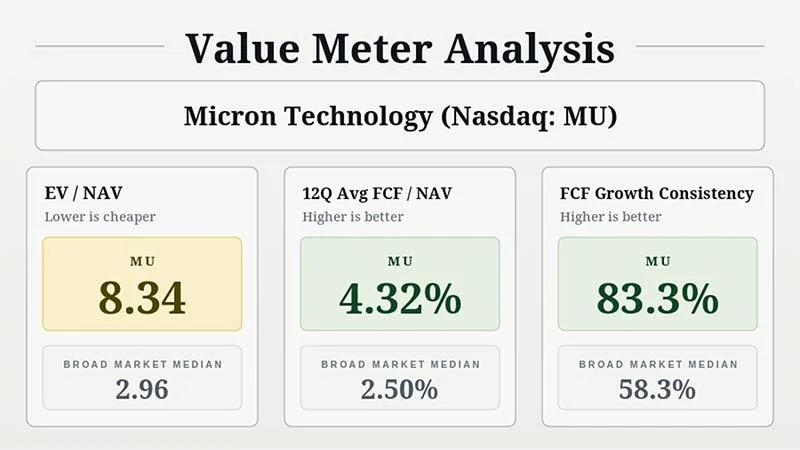
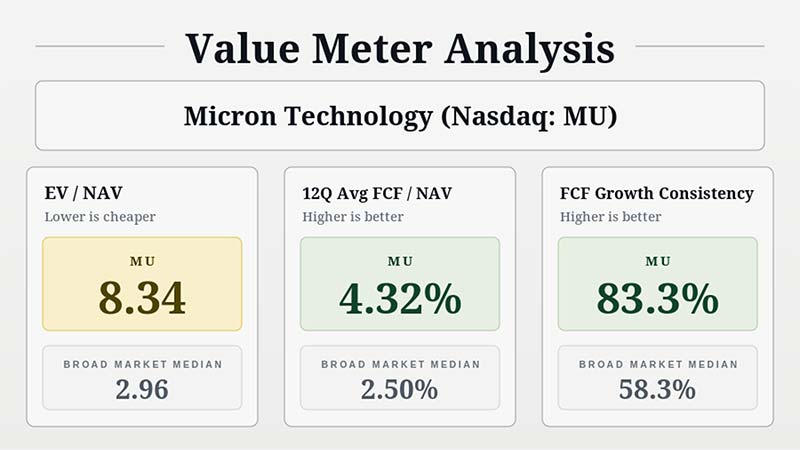
Micron’s operating results are one part of the valuation question; the price investors are paying for the business is another. The Value Meter model cited in the source puts Micron’s enterprise value at 8.34 times its net asset value, or NAV—the value of its assets after liabilities are subtracted. The median for the model’s broader group is 2.96 times NAV, while the technology sector median is 4.55.
On that measure alone, Micron carries a substantial premium. Its cash generation offers one reason the model gives for that valuation. Over the past 12 quarters, average quarterly free cash flow was 4.32% of NAV. That compares with 2.50% for the broader group and 3.61% for the technology sector.
The direction of cash flow adds context. Micron’s cash flow improved year over year in 10 of those 12 quarters, or 83.3% of the time. The comparable rate was 58.3% for both the broader group and the technology sector. These figures point to strong cash output and repeated improvement over the period measured. They cannot establish how cash flow will behave if memory prices fall or demand weakens.
That distinction is useful when considering a company with both unusually strong reported results and large planned spending. Cash generation can support investment and make a high valuation easier to explain. But factory spending also commits substantial resources before the next cycle’s conditions are fully clear. Contracts may add stability, while the company’s results remain tied to how much memory customers want and how much capacity suppliers bring online.
What the rating says—and what it leaves open
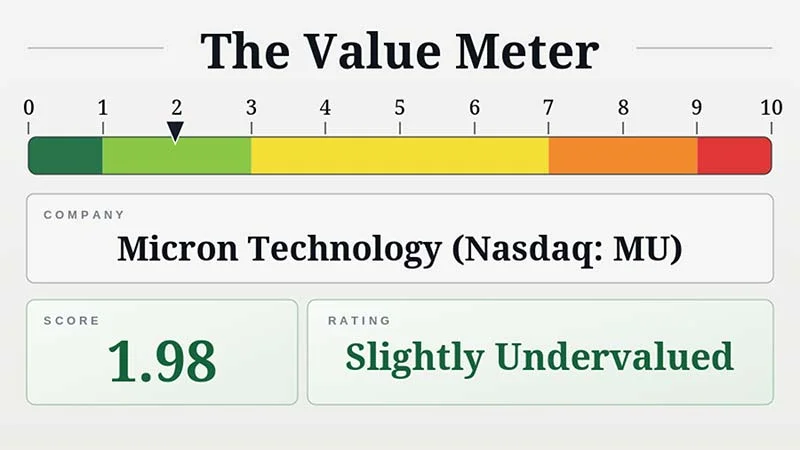
The Value Meter rates Micron “Slightly Undervalued,” judging its cash strength and steady improvement sufficient to outweigh its steep price. That is the model’s assessment, not a promise that the shares will rise or that recent business conditions will persist.
For households evaluating financial commentary about a single company, the useful takeaway is the tension behind the rating: Micron’s earnings and cash flow have surged alongside AI-related memory demand, and its contracts may soften some future volatility. Yet capacity expansion is expensive, and the supply-demand cycle still shapes the business. The numbers describe a strong period; the next test is whether demand can absorb the added production.
The original post, Has AI Changed Micron’s Business for Good?, appeared on Wealthy Retirement.