AI’s Next Growth Phase Could Bring Bigger Gains and Sharper Swings
The AI boom may have room to run, but steep drops can test investors. Position size, diversification and a clear exit plan can help manage risk.
The next leg of the AI boom could reward investors who stay invested through turbulence, but expecting a smooth climb would be a mistake. The source author sees the market entering a second phase, with the possibility of large gains alongside sharp setbacks. That view is a forecast, not a guarantee—and the article’s own examples show why managing risk matters as much as spotting a promising trend.
The tension is familiar: early investors in Apple, Amazon and Nvidia saw enormous gains, but those companies also endured declines of 90% or more along the way, according to the source. Returns of that scale are difficult to capture if a steep fall prompts someone to sell. For households, the practical question is less whether a technology story sounds compelling and more whether their savings and temperament can withstand its swings.
A long boom can still include painful drops
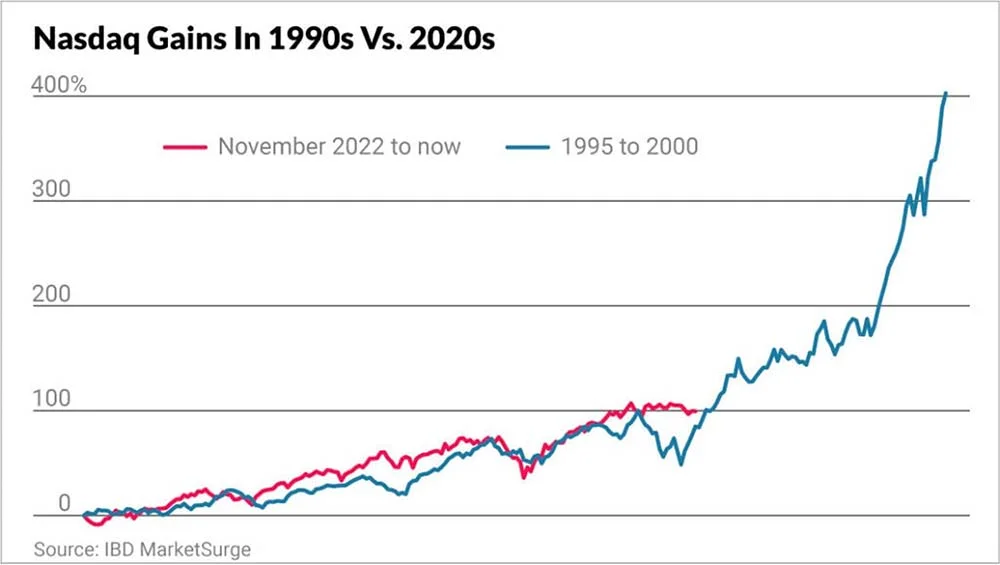
The author compares the current decade’s technology surge with the 1990s. In late 1996, Alan Greenspan warned of “irrational exuberance.” The Nasdaq later doubled, then doubled again, the article says. The author takes that history as a reason to think the current boom could continue, perhaps with a similar pattern. History can offer a comparison, though it can’t tell investors how the present cycle will unfold.
Ray Dalio, founder of Bridgewater Associates, is quoted as saying, “We’re close to the point where the AI bubble could burst.” The source author questions how much weight to place on that warning, describing Dalio’s forecasting record as mixed. The wider point is that confident predictions can pull in opposite directions. One person sees room for further expansion; another sees a possible bubble. Neither view removes the risk of being wrong.
The author expects corrections, including severe ones, but believes any technology sell-offs will be temporary interruptions in a longer bull market lasting through the decade. That outlook should be read as an opinion. A long-term thesis doesn’t prevent a major decline, and an investor who needs the money soon may have little time to wait for a recovery.
What the article calls Phase 2
The source labels the next stage “Phase 2” and connects it to a possible wave of AI-related company listings. It says Anthropic, the owner of Claude, filed to go public that morning and was expected to be valued between $1.5 trillion and $2 trillion. The company could begin trading as soon as the following month, the article says. Those details describe the source’s publication moment; they are not a current status update.
The author also estimates that $4 trillion in AI company listings could arrive in the next 12 months, and predicts that Anthropic’s market debut could lift AI shares. Those are projections, not settled outcomes. A highly valued listing can attract attention, but attention alone doesn’t establish what a company is worth or how its shares will perform after trading begins. The article points to SpaceX and Nvidia as prominent names in the AI market, while suggesting Anthropic may be another major opportunity.
For a household considering exposure to a fast-moving sector, a headline about a large listing is a reason to pause and examine the risks, rather than a signal to rush. A company’s prospects, the price investors pay, and the broader market’s mood can all affect results. The source does not provide a method for estimating a fair price or evidence that the projected listing wave will arrive as described.
Plan for volatility before it arrives
The author’s main caution is that being right about AI’s long-term potential may not be enough. Shares can fall sharply even when the broader technology story remains intact. Nvidia, for example, is described as having dropped around 80% during the 2008 financial crisis before recovering and rising later. The source also says stocks that eventually post gains of 300% to 400% may repeatedly fall 30% to 40% on the way up.
Those numbers make the human side of investing hard to ignore. A decline can feel like evidence that the original idea has failed, even when it may be part of a volatile market. Selling during a downturn can lock in a loss and leave an investor out of a later rebound. Holding on through every decline carries its own risk: a recovery may take a long time, or may not arrive. The right approach depends on a person’s time horizon, financial needs and capacity for loss.
The source names position sizing, diversification and a clear exit strategy as ways to manage exposure. Position sizing means deciding in advance how much of a portfolio to put at risk in one holding. Diversification spreads exposure across different holdings, so one company’s fortunes have less influence on the whole portfolio. An exit plan sets conditions for reducing or ending a position before pressure rises. These tools can help structure decisions, but they can’t prevent losses or ensure that someone sells at a favorable point.
The article also describes short-term trading services that aim to enter during uptrends and leave during downtrends. It mentions TradeSmith, which it says uses AI to analyze stocks and produce trading forecasts, including for technology-related shares. Trading tools and forecasts come with uncertainty: a model’s signals can be wrong, and frequent buying and selling can introduce costs or prompt decisions that don’t fit a household’s goals. The source links to TradeSmith; that link is included as a reference to the service discussed, not as a recommendation.
Keep the decision tied to your own timeline
The article’s most useful takeaway is that a promising technology theme and a suitable household investment are different questions. A long-term investor may be able to tolerate larger swings than someone who expects to use the money soon. Before taking on concentrated exposure, it helps to consider how a substantial decline would affect essential savings, planned expenses and the ability to stay with a chosen plan.
The source refers readers to a previous piece about lower-risk strategies through this article and includes a chart comparing Nasdaq gains in the 1990s and 2020s: 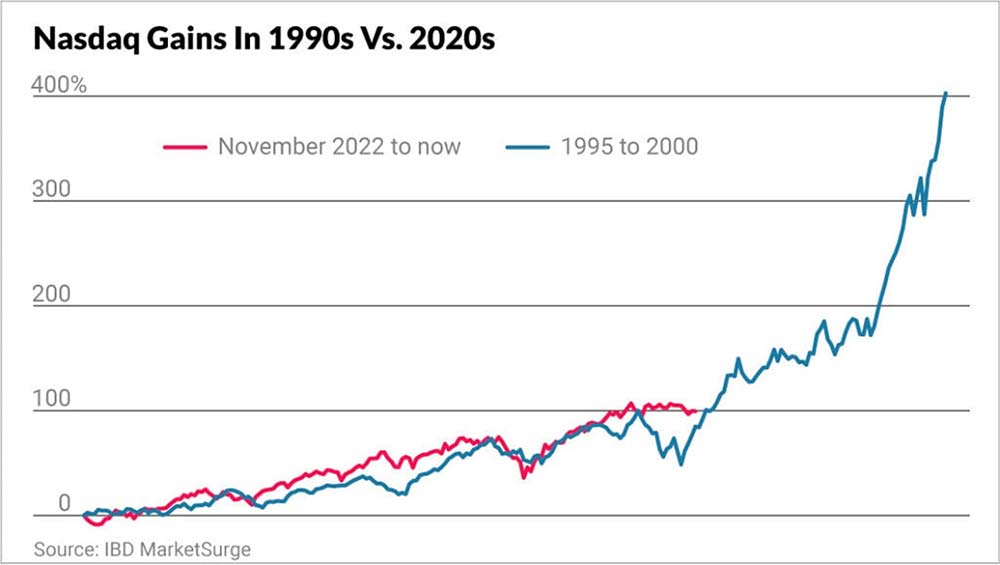 . The comparison illustrates the author’s case for further growth, but it can’t establish that the two periods will match.
AI may have another strong phase ahead, as the author believes. The practical step is to decide in advance how much uncertainty a portfolio can bear, then make choices that remain manageable if the next move is down. That preparation matters most when the market is moving fast and confidence is easiest to mistake for certainty.