Seasonal Tomato Soup and Half-Price Meat: Making Food Go Further
Use the last garden tomatoes for an adaptable soup, then stretch a food budget by preparing discounted meat joints for several meals.

Turn the last tomatoes into lunch
When fresh tomatoes are nearly finished for the season, a simple soup can put the final harvest to good use and provide a few inexpensive lunches. This version uses roasted tomatoes, garlic, basil and vegetable stock, with quantities adjusted to fit what’s on hand. The cook wasn’t expecting to enjoy it so much, but plans to make more next year.

There were only a few small tomatoes left for salads, but preserved supplies, including chilli jam and passata, will help carry the household through the months when fresh tomatoes aren’t in season. Using homegrown produce can keep the cost of a meal low, especially when it would otherwise be left unused. The writer says tomato soup isn’t usually a favourite, but a bowl is welcome on a cold day.
To make the soup, roast the tomatoes with peeled garlic cloves. In this batch, two small trays of tomatoes went into the air fryer with 12 cloves of garlic. The larger tomatoes were mostly peeled first, though the skins can be left on; roasting makes them easier to remove later. If garlic is in short supply, cooked onion can be added before blending instead.
Chop a handful of fresh basil and put it in a large jug with the roasted tomatoes and garlic. Blend the mixture in the jug to help contain splashes from a hand blender. Then add vegetable stock, starting with roughly a third to half as much stock as the blended tomato mixture. The amount is flexible, so the soup can be made thicker or thinner to suit what’s available and how it will be served.
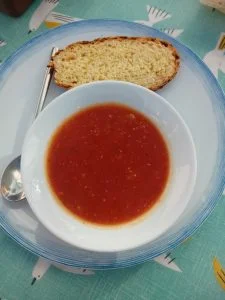
This batch used a stock cube because homemade stock had run out and there wasn’t freezer space to store more. White pepper and a pinch of salt went in too. After blending and seasoning, the soup was heated on the stove for a few minutes. The seeds stayed in, though anyone who prefers a smoother finish can strain the soup after adding the stock.
There’s room to adapt the recipe around surplus vegetables. The writer suggests adding carrot or butternut squash, which can help use up ingredients that might otherwise sit in the fridge. The useful habit is to treat the amounts as a guide rather than a fixed shopping list: start with the tomatoes, add what’s available, and adjust the stock and seasoning as you go.
The soup made enough for two or three lunches. It was served with cheese soda bread cooked in the air fryer, made from a recipe shared in the writer’s Facebook group and adjusted to use ingredients already at home. A separate recipe was due to follow later that week. The writer is also considering making extra soup next year and preserving it using a water bath. For now, this batch shows how a small amount of seasonal produce can become several meals.
Use a seasonal meat offer across several meals
Food spending can also be managed by buying an ingredient when it’s discounted and preparing it for different meals. In November, the writer often sees supermarket meat joints reduced by half. The household bought five joints and planned to turn them into sausage, mince, chunks and steaks, aiming to have meat on hand until the offers return in March for Easter.
The approach makes sense for a household that has the time and equipment to process and store a larger purchase. One discounted joint can provide several kinds of meals, while dividing the meat into portions makes it easier to use over time. The writer also renders lard from the joint for cooking, making use of another part of the purchase.
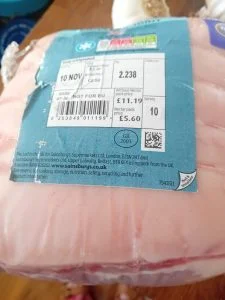
Price and quality both factor into where the writer shops. Waitrose and Sainsbury’s are preferred for meat, which the writer considers better quality. They cost a little more than some other supermarkets, but the discounted joints were still described as good-sized and around £6 each. One pictured joint cost £5.60, compared with a full price of £11.19. These are examples from the writer’s shopping, not a promise that the same prices or offers will be available elsewhere.
The writer says some other supermarkets add potato starch to bulk out their joints. Their preference is to spend slightly more at the chosen stores when a half-price offer brings the cost within reach. They would rather buy chicken breasts from a butcher, but say their budget makes the discounted joints a practical option. That trade-off will depend on each household’s budget, storage space, portion needs and preferences.
Before buying several joints, it helps to have a plan for how they’ll be portioned and stored, and to check that the total fits the food budget. A discount only helps if the food can be used. For this household, processing the meat into several forms provides flexibility: steaks, chunks, mince and sausage can suit different meals. The writer links to posts about making meals from a half-price pork joint, making pork sausage meat and making breakfast sausages.
Seasonal cooking and planned bargain buying solve different parts of the same household problem: making ingredients last. The tomatoes become lunches before the harvest runs out, while discounted joints are divided to cover meals later in the season. The practical takeaway is to match each purchase to a clear use, then make the most of what comes home.