Bloom Energy’s Rapid Growth Still Needs to Show Up in Cash
Bloom’s sales and operating profit surged, but negative free cash flow and a steep valuation leave the company with more to prove.
Bloom Energy has shown it can deliver power equipment quickly to customers facing urgent electricity needs. The harder question is whether that fast-growing business can produce enough cash to support the expectations reflected in its share price.
Bloom makes fuel cells that convert fuels such as natural gas into electricity at a customer’s site. For data centers, that can offer a way to get power while work on a grid connection is still pending. Bloom says it supplied Oracle with a working power system in 55 days last year. Oracle later signed an agreement for substantially more of Bloom’s equipment.
That example points to the appeal of on-site power: a customer may be able to bring equipment into service without waiting for every part of a new grid connection. But speed of delivery is only one part of the business case. Bloom also has to manufacture and deliver equipment at scale, manage the costs that come with expansion, and collect enough cash from its sales to fund its operations and investment in facilities.
Sales and operating profit have surged
Bloom’s recent revenue figures show a sharp acceleration. Sales topped $1 billion for the first time in the second quarter. In the third quarter, revenue reached $1.24 billion, 138% higher than a year earlier. Operating profit rose to $225 million from less than $8 million over the same comparison.
Those results help explain why customers and market participants are paying attention. Data centers running AI chips need substantial amounts of electricity, and Bloom offers equipment that can generate power at the site. The Oracle delivery also gives the company a concrete example of a rapid installation, alongside a later agreement for more equipment.
Still, higher revenue and operating profit don’t by themselves show how much cash the company has available. Operating profit is an accounting measure; it doesn’t subtract all the cash spent on equipment and facilities. That distinction matters particularly for a company growing quickly, because expansion can require significant spending before the resulting business generates cash.
Third-quarter cash flow was negative
In the third quarter, Bloom used more than $27 million in cash from operations. It also spent about $153 million on plants and equipment. After that spending, free cash flow was negative by about $181 million.
Some of this pressure may reflect the costs of meeting rising demand and building capacity. Yet negative free cash flow means that, in this quarter, the cash generated by operations did not cover the company’s investment in plants and equipment. A growing sales pipeline can support future revenue, but it doesn’t remove the need to pay for production and expansion in the meantime.
The next evidence to watch is whether Bloom can keep delivering growth while improving cash generation. A single quarter does not establish the longer-term direction, and the source figures don’t explain how much of the cash use came from any one cause. But the contrast between strong reported profit and negative free cash flow is central to judging how well growth is translating into financial capacity.
A steep valuation raises the bar
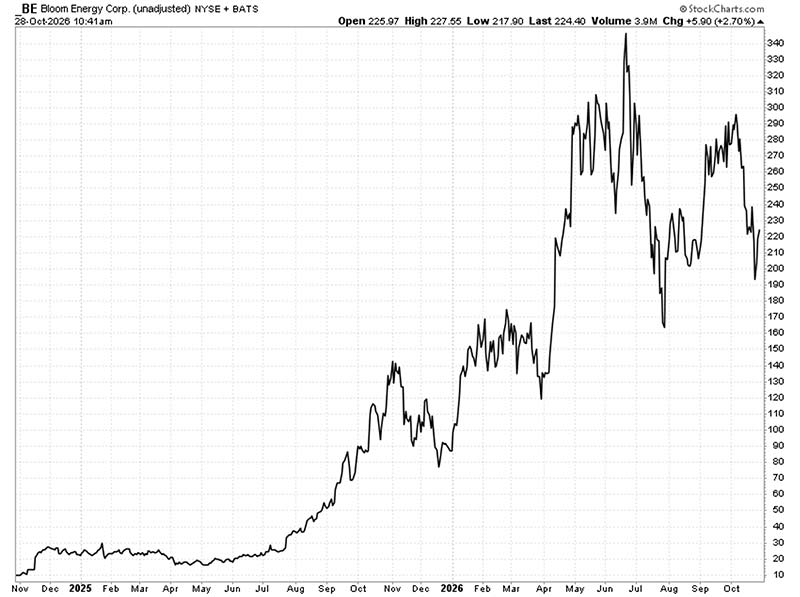
Bloom’s shares rose from around $20 in early 2025 to more than $340 this summer, before pulling back to about $220 this week. Even after that decline, they remained well above their level less than two years earlier. Such a rise makes the company’s ability to meet future expectations an important part of the discussion.
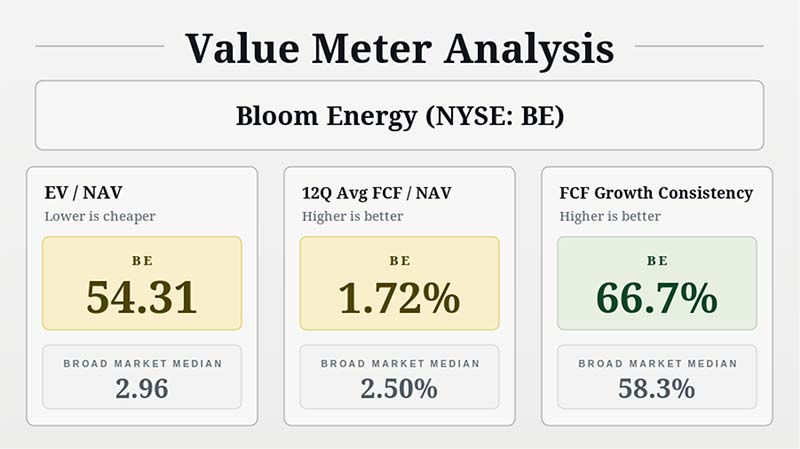
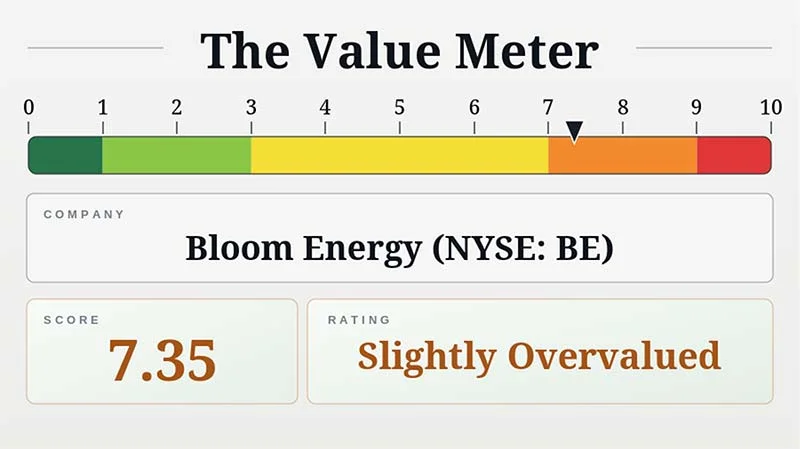
The Value Meter compares Bloom’s enterprise value with its net asset value, or NAV: the value of assets after liabilities are subtracted. Bloom’s enterprise value was 54.31 times its NAV. The median for the broader group of stocks in the analysis was 2.96, while the industrials sector median was 3.50.
Those ratios don’t capture every potential source of business value. Bloom’s technology and customer relationships may be worth more than the assets recorded on its books. Even so, the gap between Bloom’s ratio and the two medians shows how much confidence the valuation appears to place in the company’s future.
Cash generation remains a key test
Over the past three years, Bloom’s average quarterly free cash flow was equal to 1.72% of its average NAV. The corresponding median was 2.50% for the wider group and 2.95% for industrials. These measures suggest that Bloom’s longer-run cash generation has not matched those comparison points.
There is a more encouraging trend in the quarterly figures: Bloom’s free cash flow improved year over year in eight of the past 12 quarters, a rate of 66.7%. The rate was 58.3% for both the wider group and the industrials sector. That pattern shows progress, though it doesn’t erase the recent cash outflow or establish that future quarters will improve.
The Value Meter rates Bloom Energy as “Slightly Overvalued.” My read is that demand and delivery speed give the company a compelling growth story, while its cash flow and valuation leave less room for execution to fall short. For readers following the business, the useful test is whether future sales growth comes with stronger cash generation.
What company should the Value Meter assess next? Share its ticker symbol in the comments.